Most people who try Locust Pose lift from the wrong place. They clench the lower back, kick the legs up, and finish with a compressed, achy lumbar spine and an upper back that barely worked. The pose is meant to do the opposite. It asks the muscles between and below your shoulder blades to work, because those are the muscles a desk, a phone, and a steering wheel teach us to switch off. The key is to lift and lengthen first, then align, then bend. We follow this by holding the pose and growing into place – this strengthens us.
I’ve practiced yoga for over 50 years and taught for nearly 30, and I still use Locust as a daily move to improve alignment. Lying face down removes the usual compensations, and you find out quickly what your back can and can’t do on its own.
What Locust Pose Actually Trains
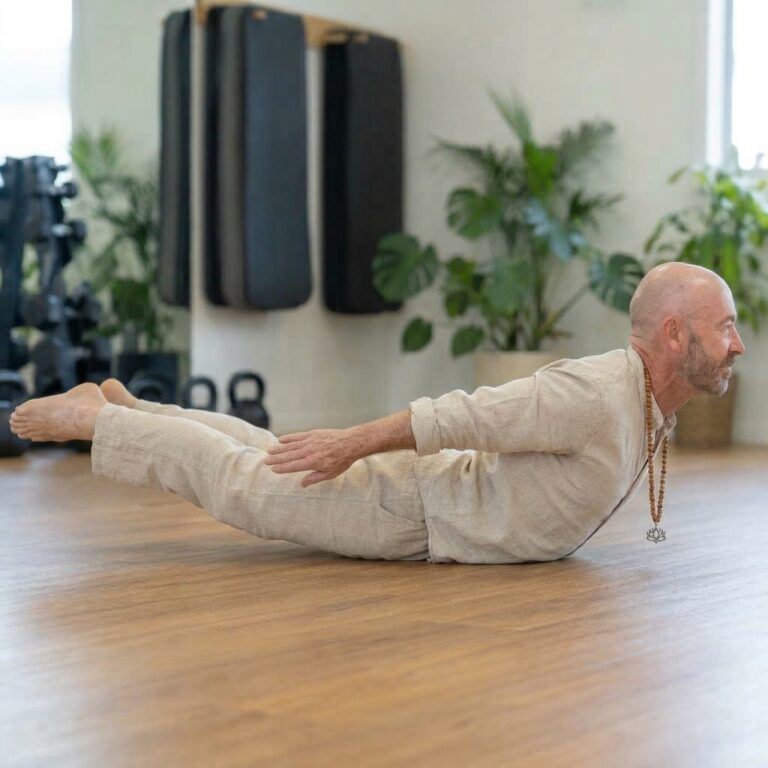
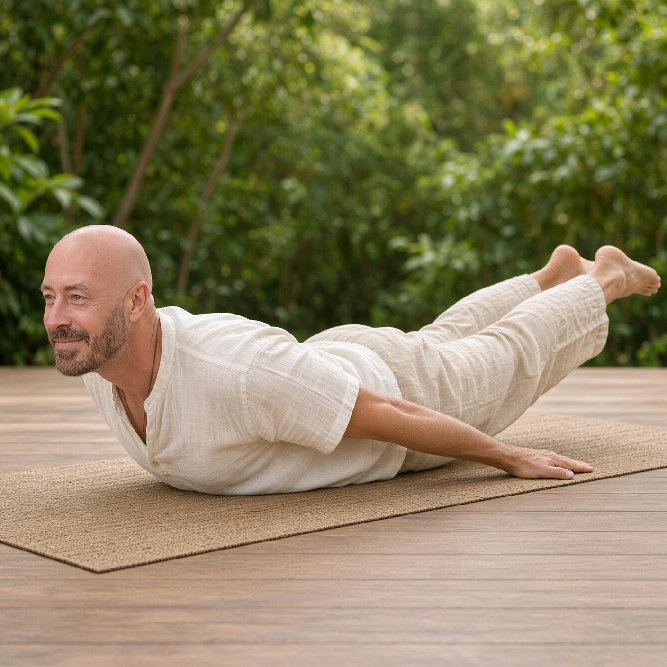
Locust (Salabhasana) is a prone backbend. You lie on your belly and lift your arms, chest, and legs away from the floor. The working muscles are the spinal extensors along both sides of the spine, the lower trapezius and rhomboids that draw the shoulder blades down and together, and the glutes and hamstrings at the back of the legs.
In fact, hours of sitting stretch and weaken those muscles. The chest muscles in front shorten, the head drifts forward, and the upper back rounds. Locust gives the back of the body a strengthening job, and the other backbends tend to blur that into flexibility. I’d call it a posture practice with a pose attached.
 Before You Lift: Set Up the Foundation
- First, lie face down with your forehead resting on the mat and your legs about hip-width apart. Press the tops of your feet into the floor and turn your toes straight back.
- Next, place your arms alongside your body with the palms facing down.
- Then, draw your lower belly gently in and up, as if lifting it a finger’s width off the floor. This light support protects your lumbar spine.
- After that, lengthen your tailbone toward your heels. This one cue changes the whole pose, because it stops you from cranking the lower back.
- Finally, let your pubic bone stay heavy on the mat.
The Three-Stage Locust Pose (Start Here)
So I teach Locust in stages, even to experienced students. Each stage teaches your body something the next one depends on.
Stage one: arms only. Inhale to prepare. As you exhale, lift your arms a few inches off the floor and keep your forehead down. Slide your shoulder blades down your back, away from your ears, and feel them move slightly toward each other. Also, your neck stays long. Then hold for three slow breaths and lower on an exhale.
Stage two: add the chest. From the same setup, exhale and lift your arms, then continue lifting your head and chest. Keep your eyes on the floor a few inches ahead of you. If you look forward, the back of your neck shortens and compresses. The lift should come from your mid-back, the area behind your breastbone. Hold for three to five breaths. Lower on an exhale.
Stage three: add the legs. Lift your arms and chest, then lift both legs from the back of the thighs, knees straight and inner thighs gently squeezing toward each other. Your belly is the pivot point of the whole shape, so think of lengthening in both directions at once: crown of the head forward, toes back. Hold for three to five breaths, then lower down and turn your head to one side to rest.
Repeat the full sequence two or three times. Your breath should keep moving throughout. If you find yourself holding it, you’re pushing too hard.
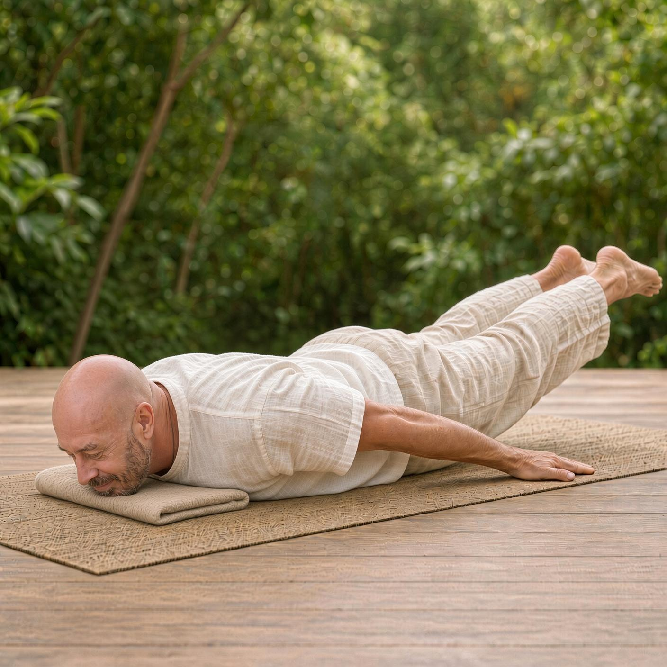 What You Should Feel (and What You Shouldn’t)
You should feel a working, muscular effort along both sides of your spine, between and below the shoulder blades, and in the backs of your legs. A mild fatigue is the point. As I say nearly daily, “Activate don’t aggravate”.
Stop or reduce the lift if you feel pinching or a sharp compression at your waist, tingling or numbness in the arms or legs, or strain at the back of the neck. Therefore, those signs mean the lift is coming from the lower back or neck. Come down and go back to stage one.
Locust Pose Modifications
- Sensitive lower back: Place a folded blanket under your pelvis and stay with stages one and two. In fact, many people never need the leg lift to get the benefit.
- Stiff or painful neck: Rest your forehead on a folded towel and keep your gaze down. Lift the chest a smaller amount.
- Tight or sore shoulders: Rest your arms alongside your torso, palms down, and lift the chest without raising the arms.
- Building strength gradually: Lift one leg at a time, alternating sides, once your chest lift feels steady.
- Who should check with a clinician first: anyone who is pregnant, recovering from spinal surgery or a fracture, living with osteoporosis or a disc injury, or dealing with acute back pain.
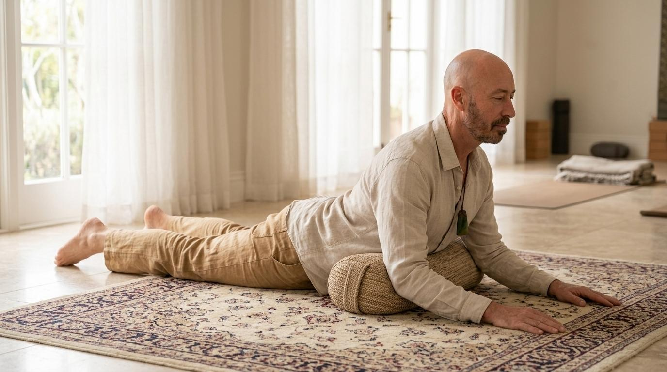 Finish Locust Pose With a Counter-Pose
After your last round, press back into Child’s Pose. Kneel, sit your hips toward your heels, fold forward over your thighs, and rest your forehead on the floor or on stacked fists. Breathe into the back of your ribs for five to eight breaths. The fold releases the extensors you just worked and lets the nervous system settle.
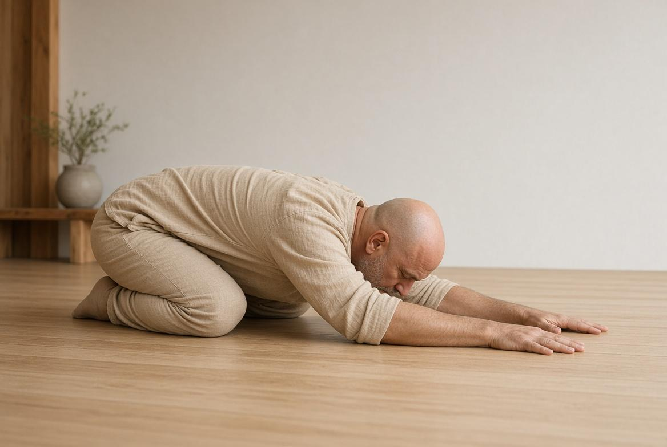 Making It a Daily Habit
Done every day for a few minutes, Locust becomes a quiet reset for the muscles that hold you upright. Over time many people notice they stand taller without thinking about it, and that tells you something about how closely posture and attention are connected. In the yoga tradition, a lifted chest is said to go along with a lifted mind. I offer that as a perspective rather than a medical claim, but it matches what I see in practice: the way people hold their bodies and the way they carry themselves through the day are rarely separate things.
Ready to start improving and reach your goals? Click here and let’s talk.
Wishing you health and peace,
Heal. Align. Thrive. 🧘
Dr. Sattva