Key Takeaways
| What to know | Why it matters |
|---|---|
| Soreness is repair, not damage | Post-practice inflammation is part of how tissue adapts. Erasing it completely is not the goal. |
| Menthol has the best evidence of the plant actives | In a head-to-head test against ice, a menthol analgesic reduced pain more and allowed greater force output. |
| Arnica helps late, not early | One trial found relief showing up around day 3 after hard eccentric work, not in the first 24 hours. |
| CBD topicals are genuinely mixed | A DOMS trial found no benefit over placebo. A thumb arthritis trial found real improvement. Both are true. |
| High-dose NSAIDs can cost you adaptation | 1,200 mg of daily ibuprofen cut quadriceps growth roughly in half over 8 weeks compared to low-dose aspirin. |
| Ahimsa is a practice, not a product | The jar is a tool. The restraint is yours. |
Your Hamstrings Hurt and You Want It Gone by Tomorrow
Here’s the short answer.
A plant-based topical is a reasonable first move. It’s a gentler one than reaching straight for ibuprofen.
Menthol has the strongest evidence. Arnica is decent, but late. CBD is honestly mixed.
None of them speed up healing.
What they do is take the edge off so you can sleep, move, and get back on the mat. That distinction is the entire point of ahimsa in recovery.
What Ahimsa Actually Says (And What It Doesn’t)
Patanjali lists ahimsa first among the yamas in Yoga Sutra 2.30. The word breaks down simply: a means not, himsa means harm. Sutra 2.35 puts it as ahimsā-pratiṣṭhāyām tat-sannidhau vaira-tyāgaḥ, which teachers render roughly as: hostility falls away around someone rooted in non-harming.
Now, a detail most recovery articles skip. Strictly read, the yamas govern how you behave toward others. The idea that ahimsa means “be gentle with your own body” is a modern extension, and teachers at Ekhart Yoga and elsewhere have written about that tension openly. I think the extension is worth making anyway. But it’s worth knowing you’re making it.
Three ways the classical texts describe causing harm:
- Physical, through the body
- Vocal, through speech
- Mental, through thought and intention
Notice that the third one covers how you talk to yourself at 6 a.m. when your hips won’t open. If you want the deeper version of that idea, Dr. Sattva’s piece on finding peace through breath in every movement sits right next to this one.
Here’s the Truth: Yoga Is Safer Than You’ve Been Told
Yoga has an injury reputation it hasn’t fully earned. A national cross-sectional survey of German practitioners found an average of 0.60 acute injuries per 1,000 hours of practice, with Power yoga users reporting the highest rate at 1.50 per 1,000 hours. For context from the same paper: running and general cardiovascular fitness sit around 2.5 injuries per 1,000 hours, soccer 3.7, tennis 5.0, and skiing 8.0.
So the practice itself is not the problem. What tends to hurt people is a specific pattern, and the research points at it clearly.
Risk factors the studies keep flagging:
| Factor | What the data shows |
|---|---|
| Unsupervised self-study | Linked to adverse effects, alongside hand, shoulder and headstands |
| Intensity and frequency | Lifetime prevalence climbs sharply in daily, vigorous styles |
| Body region | Lower extremity injuries make up 64% of the total: hip, hamstring, knee, ankle, feet |
The good news is real. Roughly 77% of acute cases in that survey reached full recovery. Most of what you feel after a hard class is not injury at all. It’s the ordinary ache of tissue that got asked to do something new.
Why Soreness Is Not Something to Erase
Delayed onset muscle soreness shows up 8 to 24 hours after unfamiliar work and peaks somewhere around 24 to 48 hours. It’s tied to eccentric loading, the lengthening-under-load that happens every time you lower slowly out of a pose.
That inflammation is not a malfunction. It’s signaling. And when you suppress it hard enough, you can suppress the adaptation along with it.
This surprised me the first time I read it. In an 8-week trial, healthy young adults took either 1,200 mg of ibuprofen daily or 75 mg of aspirin. Quadriceps volume grew 7.5% in the aspirin group and only 3.7% in the ibuprofen group, and strength gains generally favored the low-dose group. The authors concluded that young people training for strength or size should avoid excessive anti-inflammatory intake.
Blunting the ache and blunting the benefit can be the same action. That’s the trade nobody mentions on the bottle.
What’s the bottom line here? A topical you rub on the skin over a sore hamstring is a smaller intervention than a systemic drug you swallow. That’s not a claim that it works better. It’s a claim that it asks less of your body, which is exactly what ahimsa points toward.
Rule 1: Give It 24 Hours Before You Call It an Injury
Soreness and injury feel similar at hour two and completely different at hour twenty-four. Ordinary DOMS is diffuse, symmetrical, and worst when you first start moving. It eases as you warm up.
Injury is the opposite. It’s sharp, it’s localized to a point you can put one finger on, and it gets worse with movement rather than better.
Tell them apart:
- Soreness: both sides, spread across a muscle belly, better after five minutes of movement
- Injury: one side, one spot, worse with load, sometimes swelling or bruising
- Nerve involvement: burning, tingling, numbness, or symptoms that travel down a limb
Wait a day before you decide. Most of the time the answer arrives on its own.
Rule 2: Reach for the Jar Before the Pill Bottle
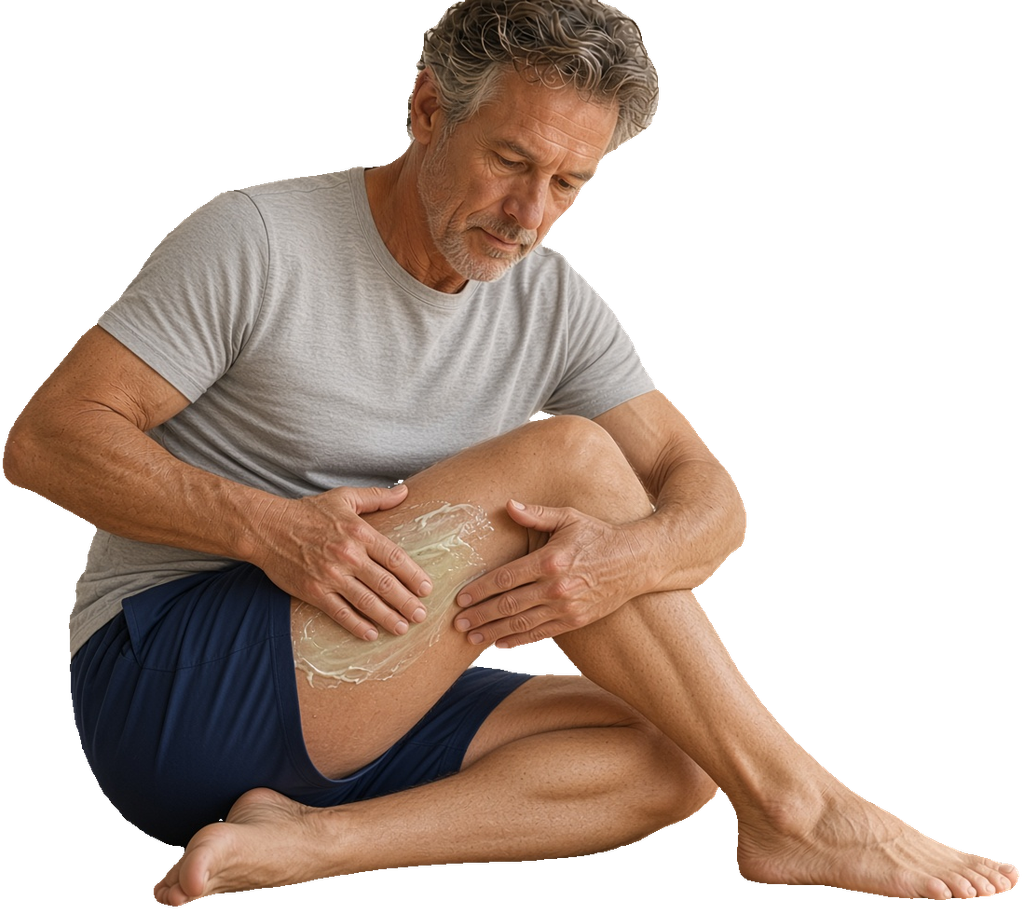
This is the practical version of the ibuprofen data above. A topical works locally. You are not asking your stomach lining, your kidneys, or your whole inflammatory cascade to participate in a sore hamstring.
That’s a smaller footprint. In a tradition built on non-harming, smaller footprints matter.
When a topical is the right first move:
- Generalized soreness after a harder-than-usual practice
- Stiff neck and shoulders after a long desk day
- Knuckles, elbows, knees, and other spots you can reach directly
- Evenings when the ache is keeping you from sleeping
When it isn’t: fever, systemic illness, suspected fracture, or anything a physician is already managing.
Rule 3: Let Menthol Do the Cooling, Not the Ice Bath
Of everything in a typical plant-based recovery balm, menthol has the most direct evidence. It’s a selective activator of TRPM8, the same channel that responds to mild cooling, which is why it produces that cold sensation without lowering tissue temperature.
The head-to-head study is the interesting part. Researchers compared a topical menthol analgesic against ice during induced DOMS. Evoked tetanic force came out 116.9% higher with the topical than with ice, and pain perception was significantly lower. Their conclusion: compared to ice, menthol cut perceived discomfort further while allowing greater force production.
Why that matters for yogis:
| Approach | Effect on pain | Effect on movement |
|---|---|---|
| Ice | Numbs, but also stiffens tissue | Reduces force output |
| Topical menthol | Counter-irritant cooling sensation | Preserves force output |
| Nothing | Slow natural resolution | Guarding and compensation |
The practical read: menthol makes it easier to move, and moving is what actually helps DOMS resolve. Read the ingredient panel and check that menthol is on it.
Rule 4: Use Arnica, But Know Exactly What It Does
Arnica montana is in nearly every plant-based recovery balm on the shelf. The evidence is real but narrower than the marketing suggests.
In a double-blind, randomized, placebo-controlled trial, 20 well-trained men ran a downhill protocol designed to induce DOMS, then applied topical arnica to quadriceps and calves. Pain relief showed up three days after the eccentric exercise. A separate 2010 trial of a 0.7% arnica ointment in 55 volunteers found no positive result at all, and actually logged higher pain in the arnica group during the first 24 hours.
What to take from two studies that disagree:
- Arnica appears to help on the back half of the soreness curve, not the front
- Concentration matters, and 0.7% may be too low to do much
- If day one feels worse rather than better, that’s been observed before and it’s not a reason to panic
Set your expectations to day three and you’ll be less disappointed.
Rule 5: The Truth About CBD Topicals (It’s Complicated)
I’d rather tell you this straight than sell you a story.
A randomized controlled trial applied topical CBD ointment after a biceps DOMS protocol at 30 minutes, 24, 48, and 72 hours. Nothing reached statistical significance on any day between the CBD and placebo arms, and soreness climbed in both. A 2024 review in The Journal of Pain was blunter still: across 16 trials of pharmaceutical-grade CBD spanning 12 pain states, fifteen showed no benefit over placebo.
And yet. A single-center randomized controlled trial of topical CBD for thumb basal joint arthritis found the opposite. Treatment improved visual analog pain scores, arm and hand disability scores, and patient self-evaluation against control, with no adverse events reported.
Here’s how I’d hold both facts at once:
| Claim | Honest status |
|---|---|
| CBD topicals cure inflammation | No. Nobody has shown this. |
| CBD reliably speeds DOMS recovery | No. The DOMS trial was null. |
| CBD may help some joint pain | Possibly. Some positive trials, small samples. |
| CBD topicals are low-risk to try | Yes, in healthy adults, on intact skin. |
| FDA has approved CBD for pain | No. One prescription CBD drug is approved, and it treats rare seizure disorders. |
One ingredient in that category does have clean mechanistic evidence, and it isn’t CBD. Beta-caryophyllene, the peppery compound in black pepper, clove, and hemp, binds the CB2 receptor selectively and acts as a functional agonist there. In the same work, oral dosing cut the inflammatory response in normal mice but did nothing in mice bred without CB2 receptors, which is about as clean as mechanism evidence gets. It shows up on some balm labels. Worth recognizing when it does.
Rule 6: Read the Ingredient List Like You Mean Ahimsa
This is where a lot of “clean wellness” branding falls apart, and where practitioners who take the yamas seriously should slow down.
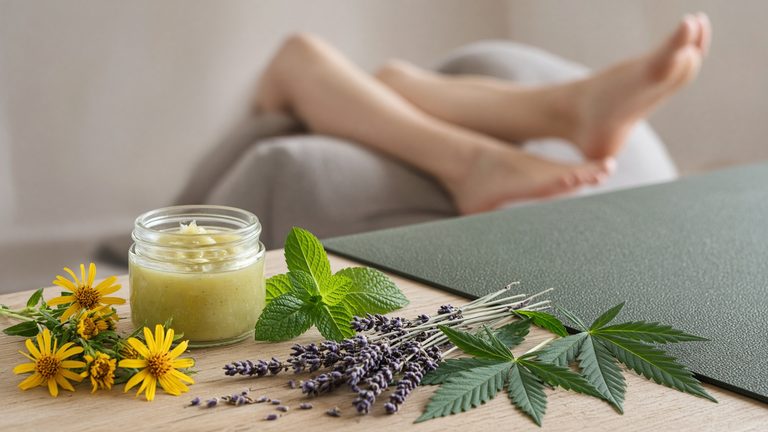
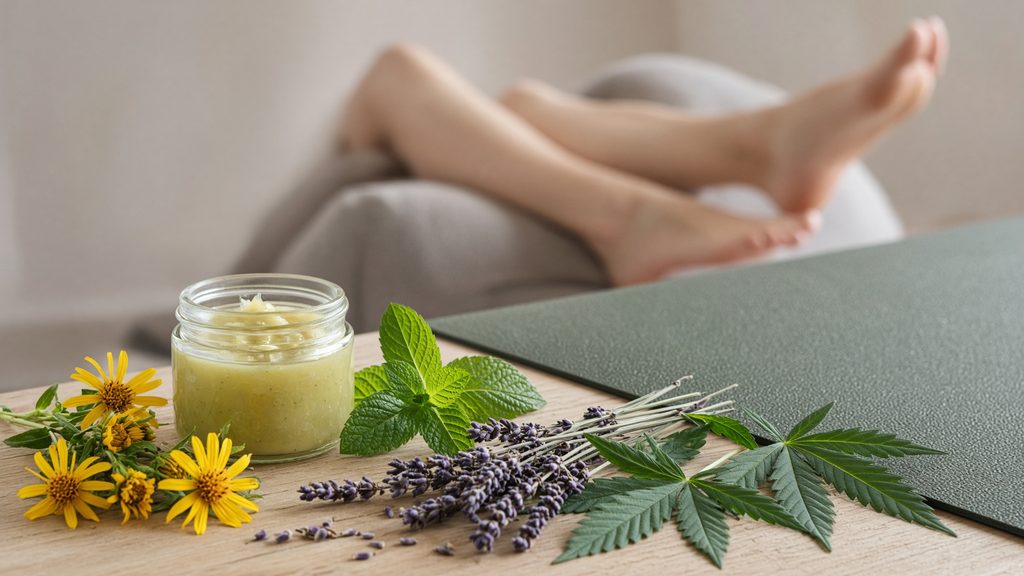
Beeswax is the common example. It’s a genuinely good occlusive for a balm, and it’s also an animal product. If your reading of ahimsa extends to what you buy, a beeswax balm is a choice you should make knowingly rather than by accident. Cream formulas typically use a plant or synthetic emulsifying wax instead, which is why the same brand can offer one vegan-friendly option and one that isn’t.
A worked example from a range of organic CBD topical creams and balms, so you can see how the labels differ in practice:
| Body balm | Body cream | |
|---|---|---|
| Format | Waxy, concentrated, targeted | Lotion texture, broader coverage |
| Active plant matter | Full-spectrum hemp, arnica, menthol, peppermint, lavender, beta-caryophyllene | CBDA plus CBD, arnica, aloe vera, chamomile, cocoa butter, olive oil |
| Contains beeswax | Yes | No |
| Typical price | Around $20 | Around $70 |
| Best for | Knuckles, elbows, knees, a gym bag | Full limbs, daily use, drier skin |
Four label checks worth making on any brand, not just this one:
- Published certificates of analysis. Third-party batch lab results should be public, not on request.
- Actual milligram totals. “Infused with hemp” is not a dose.
- Animal-derived ingredients. Beeswax, lanolin, and carmine all show up in topicals.
- Cruelty-free certification. Leaping Bunny is the meaningful one.
Rule 7: Apply It With Your Hands, Slowly
A pea-sized amount is usually enough for hands and knuckles. For a hamstring or calf, think a thumbnail. Most people use three times what they need and then decide the jar is too expensive.
But the amount matters less than the manner. Two minutes of slow, attentive self-massage into a sore quad is doing something the cream alone isn’t. Touch modulates pain. Attention modulates the story you’re telling about the pain. Rushing the application turns a practice into a transaction.
A slower application, in four beats:
- Warm the product between your palms first so it melts rather than drags
- Work toward the heart, not away from it
- Breathe out on the pressure, in on the release
- Spend thirty seconds longer than feels necessary
If you’ve read Dr. Sattva’s reflection on finding balance at 57, you already know the pattern. Small things, done attentively, compound.
Rule 8: Never Use a Topical to Push Through
This is the rule that actually matters, and it’s the one people break.
A topical reduces the sensation of pain. It does not repair the tissue underneath. If you numb a joint enough to hold a pose your body was refusing, you have used a plant-based product to commit himsa against yourself with better packaging. That’s the trap.
Hard limits:
- Never on broken skin. Not a scrape, not a blister, not a rash.
- Never before a class to enable a pose you couldn’t otherwise hold.
- Never on a suspected acute injury in place of a proper assessment.
- Patch test first on the inner forearm, especially with menthol or essential oils.
- Talk to your doctor if you’re pregnant, nursing, or managing a diagnosed condition.
One more practical note for full-spectrum hemp products: they contain trace THC by nature. Manufacturers generally describe a positive drug test from topical use as highly unlikely, and legal products stay within the federal THC limit. If you work in a zero-tolerance role, that “highly unlikely” is not the same as “impossible,” and a broad-spectrum or THC-free formula is the more honest choice for your situation.
Rule 9: Give It 30 Days, Then Be Honest With Yourself
Recovery products are unusually easy to fool yourself about, because soreness resolves on its own regardless of what you rubbed on it. That’s the whole reason placebo-controlled trials exist.
So run a small one. Use the product consistently for 30 days on the same recurring complaint. Write down a 0 to 10 number in the morning. At the end, look at the numbers rather than the feeling. If it helped, you’ll see it. If it didn’t, you’ve saved yourself a subscription.
A simple tracking format:
| Day | Area | Morning pain (0-10) | Applied? | Notes |
|---|---|---|---|---|
| 1 | Right hamstring | 6 | Yes, PM | Hard vinyasa class |
| 2 | Right hamstring | 7 | Yes, AM + PM | Peak soreness |
| 3 | Right hamstring | 4 | Yes, PM | Noticeably easier |
Satya, truthfulness, is the second yama for a reason. It applies to the stories you tell yourself about what’s working.
A 5-Minute Post-Practice Ritual You’ll Actually Do
Elaborate recovery protocols fail because nobody does them twice. Here’s a version short enough to survive contact with a real evening.
| Minute | What you do | Why |
|---|---|---|
| 0:00 to 1:30 | Legs up the wall, slow nasal breathing | Downshifts the nervous system |
| 1:30 to 3:30 | Apply topical to the two sorest areas, slowly | Local relief plus attentive touch |
| 3:30 to 4:30 | Gentle range of motion through the same joints | Movement is what resolves DOMS |
| 4:30 to 5:00 | Sit still. Notice what changed. | Turns a habit into a practice |
Two things make this work. It’s short enough that you’ll repeat it, and it puts the product inside a practice rather than in place of one.
If your evenings are the problem rather than your hamstrings, the piece on yoga for stress relief is the better starting point. Soreness and stress load are more connected than most people assume.
When Soreness Isn’t Soreness
Some things do not belong in a jar. Stop self-treating and get assessed if you notice any of the following.
- Pain that wakes you from sleep
- Numbness, tingling, or weakness in a limb
- Visible swelling, deformity, or a joint that gives way
- Sharp pain at a single point that worsens over several days
- Soreness that hasn’t started improving after five to seven days
- Any pain accompanied by fever or feeling systemically unwell
None of these are emergencies by default. All of them are worth a professional set of eyes.
Quick Answers to Questions Students Actually Ask
Should I use it before class or after? After. Before class it can mask feedback you need.
Balm or cream? Balm for small targeted spots and travel. Cream for full limbs and daily use.
Can I use it every day? Topicals are generally well tolerated for daily use on intact skin. Patch test first, stop if irritation appears.
Does it replace stretching, sleep, or eating properly? No. Nothing does. The nutrition piece is genuinely upstream of all of this, and Dr. Sattva’s article on food as medicine makes that case better than a recovery article can.
Is arnica safe on skin? Topically, in standard concentrations, yes for most people. Not on broken skin, and not internally.
Your Turn
Ahimsa isn’t a product you buy. It’s the decision, made repeatedly, to stop asking your body for one more rep, one more inch, one more day of ignoring the signal.
A good plant-based topical fits inside that decision. It takes the edge off, it asks very little of your system, and it buys you the comfort to keep practicing. That’s genuinely useful. It is not a shortcut, and anyone selling it as one is selling you something else.
So here’s what I’d ask you to do this week.
Pick one sore area. Pick one topical with a published certificate of analysis and an ingredient list you can actually defend. Use it for 30 days, track the number, and tell the truth about the result.
Then tell somebody. Which recovery approach has actually worked for you, and which one did you talk yourself into? Leave a comment below, because the honest answers are worth more than any product page. If you want a practice built around your body instead of around a pose, look at the 1Yoga programs or get in touch directly.
Your body has been telling you something for a while. Ahimsa just means finally listening.
This article is for general education and is not medical advice. Nothing here is intended to diagnose, treat, cure, or prevent any disease. Talk to a qualified healthcare provider about your specific situation, especially if you are pregnant, nursing, taking medication, or managing a diagnosed condition.